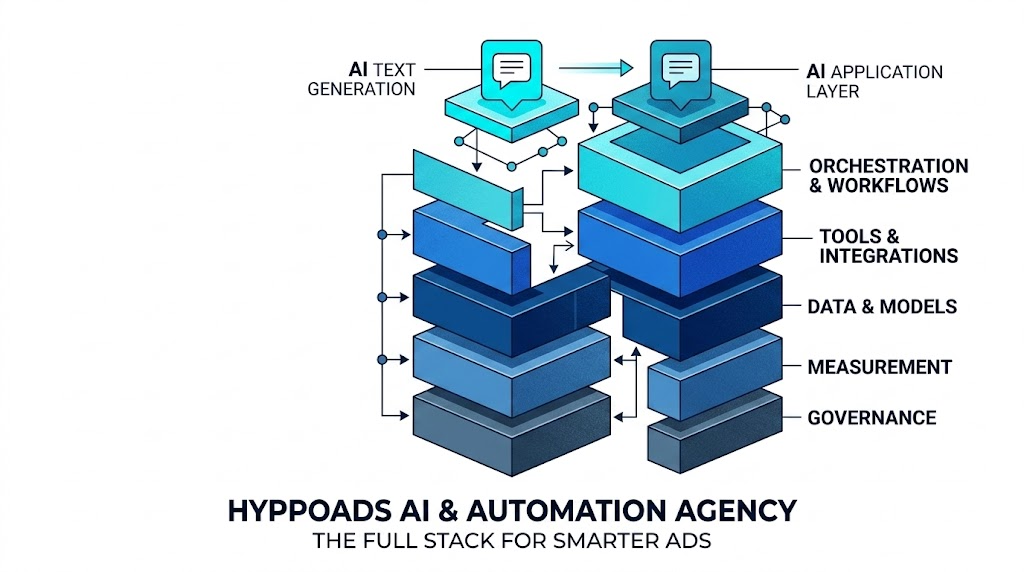
Why AI Text Generation Is Only One Small Piece of the Stack
Why AI Text Generation Is Only One Small Piece of the Stack
AI text generation tools are now everywhere. Business owners can draft emails, generate social posts, and rewrite website copy in seconds. These capabilities are useful, but they represent only a small part of what modern AI and automation systems can do for a service business.
To build a durable advantage, it helps to understand where text generation actually sits in the broader AI stack: data, models, orchestration, workflows, and measurement. When these pieces work together, AI moves from writing things faster to supporting how the entire business operates.
Text Generation vs. the AI Stack
Most people encounter AI through a chat box that produces text on demand. Under the surface, though, that chat box is just the visible tip of a layered system. A practical AI stack for a service business usually includes:
- Data sources and context
- Core AI models (including but not limited to text generators)
- Tools and integrations
- Orchestration and automation logic
- Business workflows and processes
- Analytics, feedback, and governance
Text generation lives mostly in the core AI model layer. Without the surrounding layers, it can still be handy for one-off tasks. But it struggles to consistently improve operations, customer experience, or revenue.
The Foundation: Data, Context, and Structure
AI text tools generate language, not facts. The quality and usefulness of their output depend heavily on the data and context they are given. In a business environment, that foundation matters more than the model itself.
Why data matters more than the draft
For a service business, the most valuable information usually lives in:
- CRMs and booking platforms
- Support tickets and emails
- Project management boards
- Internal SOPs and playbooks
- Pricing sheets and service menus
- Past marketing and campaign performance
When AI can access and interpret this information, it can generate messages that are aligned with real operations: accurate prices, current availability, and correct policies. When it cannot, text generation becomes a generic writing helper that still requires heavy human editing and fact-checking.
Structured vs. unstructured information
Another important piece is how information is structured. AI can work with both:
- Structured data: things like appointment times, job statuses, or revenue figures stored in clearly defined fields.
- Unstructured data: free-text notes, emails, or documents that do not follow a rigid format.
Modern AI can read unstructured data, but combining it with structured data is where more interesting use cases appear. For example, generating a follow-up message that references the specific service purchased, the date of service, and the next recommended step requires more than just language skill. It requires access to organized data.
Models: Text Generation Is Only One Modality
Text-focused AI models are powerful, but they are not the only kind of AI businesses use. A modern stack often includes multiple model types, each solving a different part of the problem.
Beyond text: other AI capabilities
Some examples of AI functions that support or surround text generation include:
- Classification: tagging leads, routing support tickets, or segmenting customers based on their messages.
- Extraction: pulling key details (names, dates, issues, budgets) from emails or forms so they can be used in downstream systems.
- Summarization: condensing long conversations, call transcripts, or project notes into clear briefs or next steps.
- Search and retrieval: finding relevant documents, messages, or policy details based on a question.
- Recommendation: suggesting next best actions, services, or content based on patterns in past behavior.
Text generation usually sits on top of these capabilities. For instance, an AI assistant might first extract key facts from a customer message, look up related account history, and only then generate a personalized response. The visible piece is the reply, but most of the value comes from the data and reasoning beneath it.
Tools, Integrations, and the Real World
Writing a great email does not schedule the job, create the invoice, or update the CRM. To make AI useful in operations, it has to connect to the tools that actually run the business.
Connecting AI to existing systems
In a typical service business, these tools might include:
- Booking and scheduling platforms
- CRM and sales tracking tools
- Helpdesk or shared inbox systems
- Accounting and invoicing software
- Internal knowledge bases or document repositories
When AI can read from and write to these systems, text generation becomes one step in a larger automated flow. For example, instead of simply drafting a reminder email, an AI system could:
- Detect which jobs are due for a reminder
- Pull specific appointment details
- Generate tailored messages
- Send them through the right channel
- Update records when a customer confirms or reschedules
In this scenario, the text itself is important, but so are the triggers, data flows, and system updates that surround it.
Orchestration and Automation: The Logic Layer
Orchestration is the layer that decides when AI should run, what it should do, and how different tools coordinate. This is where AI shifts from on-demand writing to a reliable part of business processes.
Rules, triggers, and decision flows
Orchestration can include both simple rules and more advanced logic. Common patterns include:
- Time-based triggers (e.g., follow-ups sent a set number of days after a visit)
- Event-based triggers (e.g., new lead created, job marked as complete, payment received)
- Branching logic (e.g., different messages for first-time vs. returning customers)
- Fallback paths (e.g., if AI cannot confidently answer, escalate to a human)
In many cases, the text generator is just the final step: Now produce a message that reflects this decision. The real leverage comes from consistently applying logic and data, not from the wording alone.
Workflows and Human Roles
Even strong AI systems sit inside human workflows. For service businesses, this usually means a mix of automation and human oversight rather than fully autonomous systems.
Where people stay in the loop
Common patterns include:
- Draft and review: AI prepares responses or proposals; staff review and approve.
- Co-pilot assistance: AI surfaces relevant details, suggests replies, or summarizes context, while humans handle judgment calls.
- Guardrails: certain actions (discounts, refunds, schedule changes) always require human confirmation, even if AI makes a recommendation.
Designing these workflows matters more than any single piece of generated text. If people do not trust the system, they will not rely on it, and the organization never sees the full benefit of automation.
Measurement, Feedback, and Governance
Another layer that sits above text generation is measurement and governance. Without it, it is difficult to know whether AI is helping or just producing more content.
Measuring what matters
Useful metrics typically look beyond the volume of messages created. Examples include:
- Response times to new inquiries
- Lead-to-booking or lead-to-sale conversion rates
- Customer satisfaction or review trends
- Average handling time for support or operations teams
- Percentage of messages handled without escalation
Feedback loops can also help improve how AI is used. For instance, tracking when staff frequently edit AI-generated drafts can reveal gaps in context or policy knowledge that might be addressed at the data or orchestration layer.
Why Focusing Only on Text Can Limit Results
Relying solely on text generation has a few practical downsides for service businesses.
Common limitations of text-only thinking
- Inconsistent accuracy: without proper data connections, AI-written content can drift from current pricing, policies, or availability.
- Operational friction: if staff still have to copy, paste, and update multiple systems, much of the time-saving potential is lost.
- Hard-to-measure impact: more content does not automatically lead to more bookings, higher margins, or better customer satisfaction.
- Scalability issues: workflows that depend on manual oversight for every single output can be difficult to scale as volume grows.
When AI is treated as a stack rather than a single feature, these issues become easier to address. The focus shifts from What can we make it write? to How can information, decisions, and actions move more smoothly across the business?
Thinking in Systems, Not Features
For many owners and operators, a helpful mindset is to see text generation as one interface into a broader system. That system spans data, tools, processes, and people.
Questions like What should we automate? or Where should AI help? often become clearer when broken down into layers: what data is available, what decisions are being made, which tools are involved, and where human judgment is essential. Text generation then becomes a way to express those decisions clearly to customers and staff, rather than the main event.
AI that is grounded in business reality tends to be quieter and more infrastructure-like. It routes, summarizes, nudges, and fills in the gaps so that teams can focus on higher-value work. Text output is just one of the ways that intelligence shows up.
Learn More About Building a Real AI Stack
AI text generation can be a useful starting point, but it is only one component of a modern AI and automation stack. Understanding the other layers—data, integrations, orchestration, workflows, and measurement—makes it easier to decide where to invest and what to explore next.
If you want to explore how a full AI stack might support your service business, you can connect with the team at Hyppo Advertising Inc. to learn more about practical options and approaches. Reach out here to start a conversation about where AI, automation, and better systems could fit into your existing operations.


